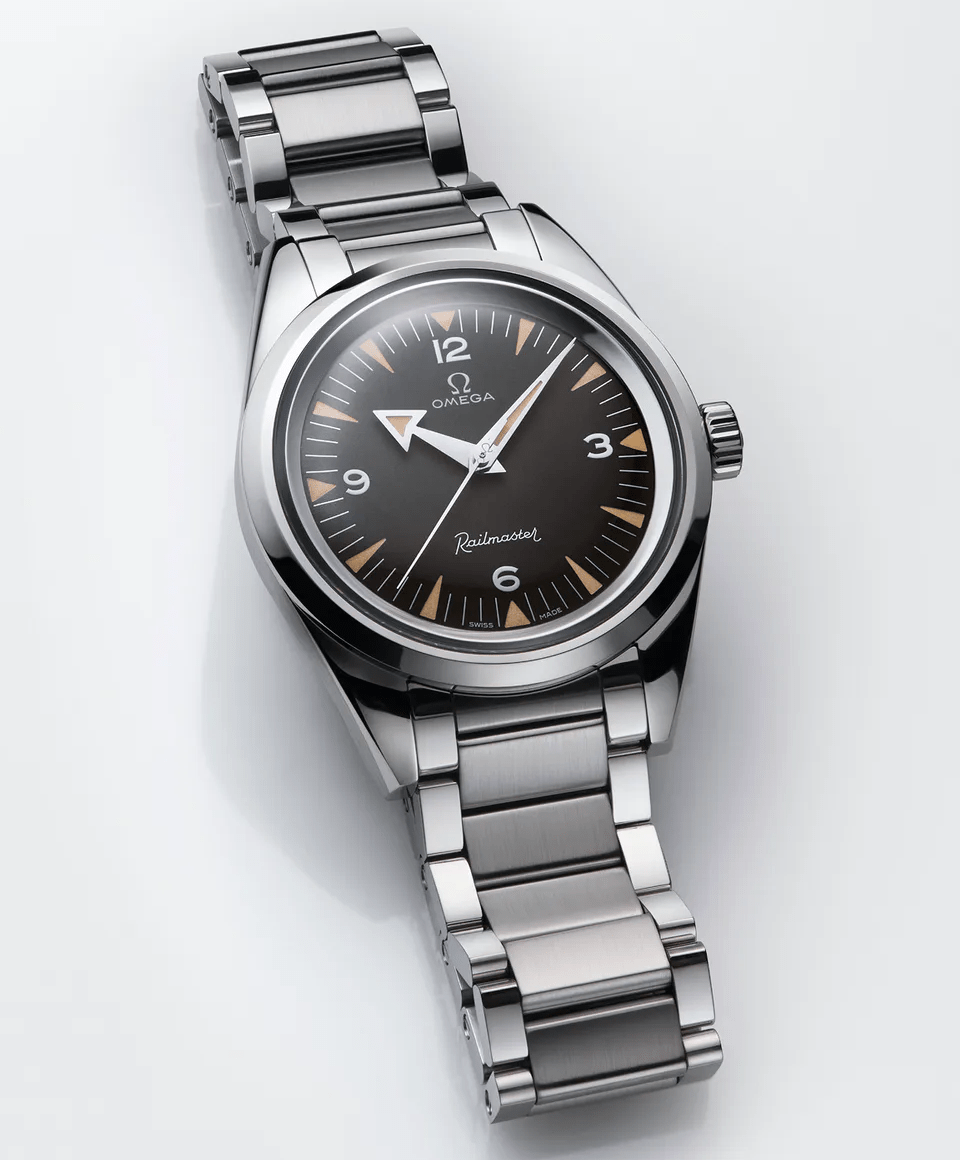
This is an article which is, eventually, going to be about the Omega “Trilogy” Railmaster 60th Anniversary Limited Edition; but between now than then it’s also going to skate over the state of the male psyche, which I’ll tell you now doesn’t come out of it well, and the end of steam travel, as well as make rude noises about people who play golf.
The way watches are marketed to men (and I specifically mean men here – women are not this stupid as a rule) is not that flattering to the male of the species. Jet pilots, rescue divers, racing drivers and soldiers are all amongst the folk watchmakers promise you’ll be more like if only you buy their watch, designed for people who do such exciting things for a living.
Of course this doesn’t work. Gavin from accounts remains a dullard no matter how many hundred meters under the Pacific his watch will work, and Tim the management consultant is still only really good at Powerpoint and charging vast sums for stating the bloody obvious, despite the fact that his watch was made for the Swedish air force.
Yet it does work for Gavin and Tim, at least as far as they’re concerned, and has been working for Gavins and Tims since the 1960s when watch companies really woke up to the power of marketing to the delicate male psyche.
I mention this because whilst pilots’, divers’ and drivers’ watches remain at the core of this stuff, there used to be a fourth category which was, once, the daddy of them all. It was railway watches.
You wouldn’t know it from looking at much watch writing, but horology didn’t start when Sean Connery strapped on a Submariner, or McQueen a Monaco. Just as watches designed to work deep under water or in a the cockpit of a fighter plane have very impressive abilities, watches designed to operate on the railways needed to be, until the late 1960s anyway, amongst the most impressive of all. Thanks to a number of terrible rail accidents in the late 19th Century, rail companies wanted their senior staff to all be operating to the same time, ideally to the second (or at least a few seconds), even when hundreds of miles apart. In issuing watch-makers with the standards they must meet to win such contracts they demanded very high accuracy, far more so than any military buyer was seeking, the greatest levels of robustness possible and, uniquely, that the watches would not be adversely affected by magnetic fields generated by railway equipment.
This latter point is important, because it matters to our story and, if you enjoy watches, it matters to you too, even today and even if you don’t know it.
Picture a mechanical watch mechanism in your mind, and then think what happens to all those hundreds of tiny parts, tuned to operate to minute tolerances, when magnetism hoves in to view, so to speak. Basically even a relatively small magnetic field can mess up the accuracy of an unprotected watch severely.
So early “rail” watches had a second inner case, later known as a “Faraday cage”, to help insulate them from magnetic fields. They were, in the first half of the 20th Century, the ultimate tool watches.
I promised we’d talk Omegas and we’re about to, but before mentioning the watch we’re going to look at today it’s important to understand that it was born just as three things related to the proud history of the railway watch were coming together – quite unhelpfully together as it turns out – in 1957.
First the magic of rail was rapidly diminishing. This wondrous technology which had opened up swathes of the world to people for more than a century via huge, powerful and beautiful steam engines, and of course the luxury and romance contained in the carriages behind them, was giving way to diesel and electric commuter trains. Rail travel was becoming humdrum, not special, and working on the trains was no longer something little boys dreamed of as once they had.
Secondly the late 50s were the start of the jet age in the public consciousness, both in terms of military aircraft and commercial ones. Planes were sexier than trains, bluntly.
And finally, as post-war austerity began to dilute, the sports car became something more people could aspire to own, not just the preserve of life’s Bertie Woosters. So cars were sexier than trains too.
It was in the middle of all this then, in 1957, that Omega decided to launch the Railmaster as a wristwatch (they’d dominated the market for rail pocket watches outside the US, where protectionist laws kept them at bay, for years). CK2914, as it was known internally, used a soft iron inner case as a Faraday cage. It featured a thicker dial to protect the movement from external magnetic fields too, a movement which was copper-finished and protected by a special double case and iron dust cover.
Ironically for one of the great houses of watch-making, this was rotten timing.
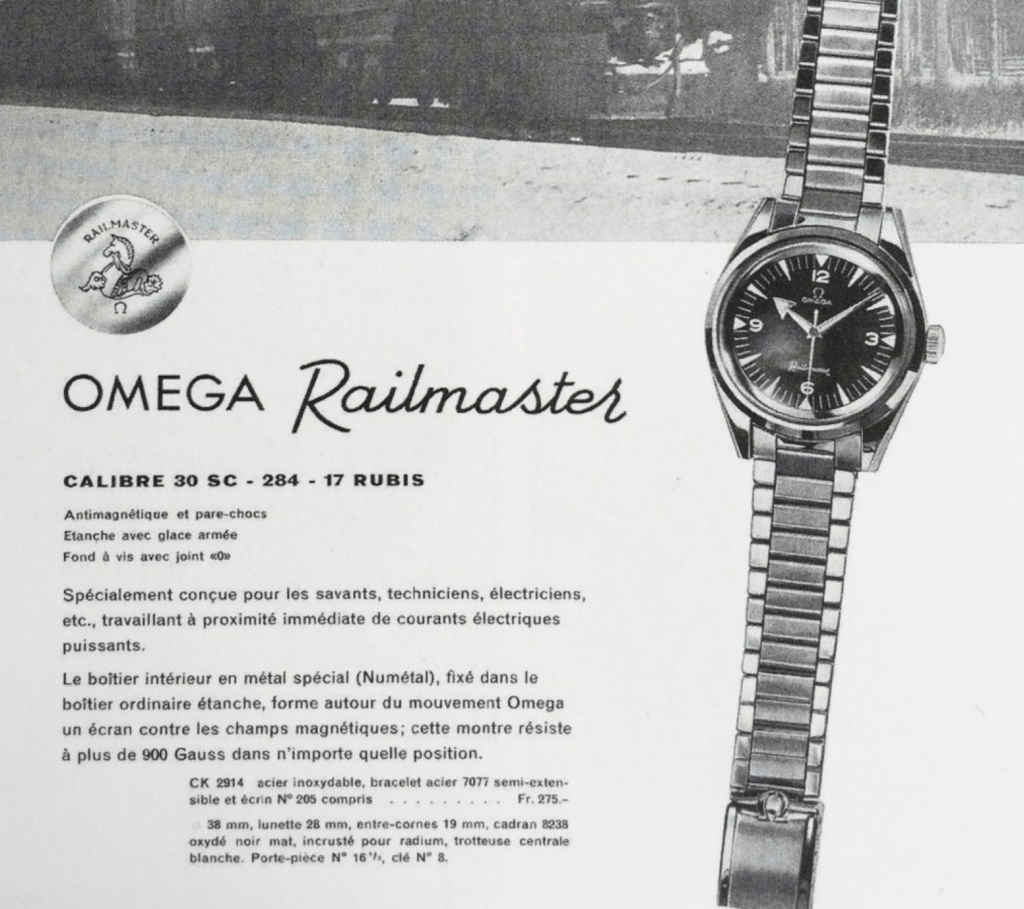
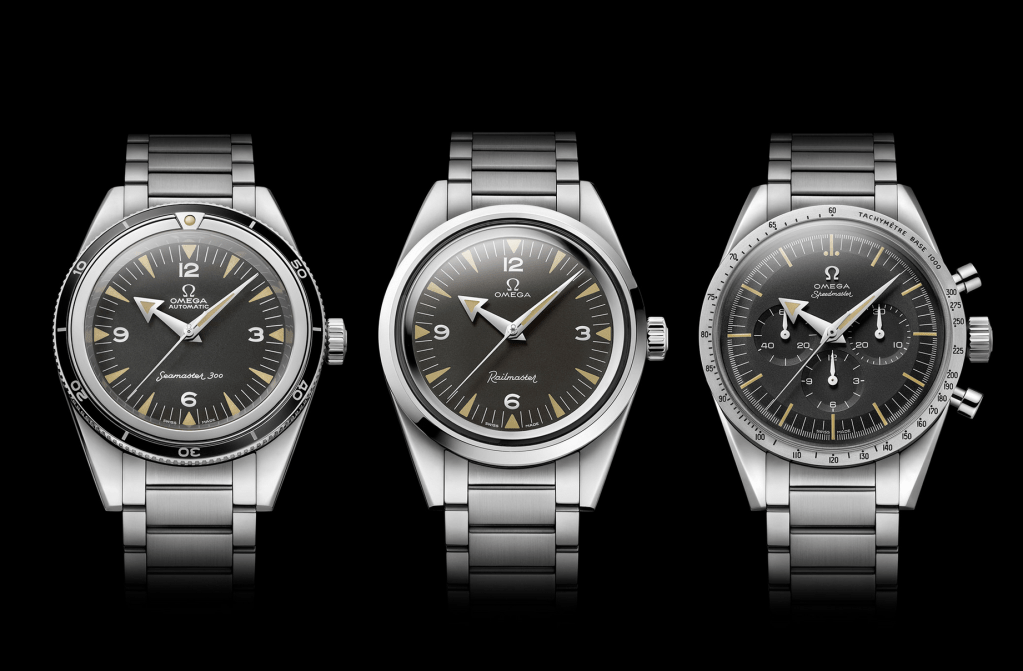
It could still have worked, perhaps, but just to ensure it didn’t Omega decided to launch three watches at the same time. The Railmaster was one, the other two were called the Speedmaster and the Seamaster, two watches that were to go on to become (and very much remain) amongst the great names in wristwatches; seminal products dominating their markets.
The great pity was that the original Railmaster was the best watch of the three. It lacked the Speedmaster’s chronograph functions (designed to time races) or the Seamaster’s diving ability, but it was resistant to magnetic fields of up to 1000 Gauss, accurate, waterproof, handsome and the most robust of the trilogy.
Omega decided to keep the rail link in the name despite the fact that the watch wasn’t aimed so much at railway staff by 1957 as at engineers and scientists, people increasingly working around strong magnetic fields as electric, electronic and industrial technology developed at an incredible pace. This was not, in retrospect, a good call. Imagine if they’d called it the Techmaster. How many of those would they be selling today?
But it was what it was and within a few years, as Seamasters and Speedmasters were seen on the wrists of adventurers and race drivers, and sold in huge numbers, the poor old Railmaster was quietly shunted in to the sidings and discontinued. It is the forgotten great in Omega’s back catalogue (although its rarity has driven vintage values sky high).
Omega made a couple of poor attempts to bring it back in the 1980s and then the 2000s, I think because they’re rightly proud of it, but none of them worked really.
But all that changed at the Baselworld watch expo in 2017. The brand unveiled a gorgeous new, modern take on the Railmaster as part of the Seamaster range (rather awkwardly called the Seamaster Railmaster). It’s a fabulously understated sports/tool watch and you should go and have a look at one. We’re not talking about that watch today though, because at Baselworld Omega did something else too. 2017 marked 60 years since the “Master” trilogy that made Omega the powerhouse it is today was born, and to celebrate this milestone they produced a very limited number of modern copies of those three watches – not modern reinterpretations of them, physically exact copies made with modern movements, tech and materials.
The Railmaster is my particular favourite (220.10.38.20.01.002 for the serial number nerds amongst you). There are only 3557 of them. At 38mm Omega resisted the temptation to upsize to modern norms, and thank goodness. Not looking like one of those awful dinner plates seen in golf club bars instantly makes the watch more, not less, special (and, ironically, noticeable). The case, the shape of which was taken from original Railmasters using 3D scanning, is made from the highest grade steel Omega use, with angles brushed to a mirror shine and satin brushing used elsewhere.
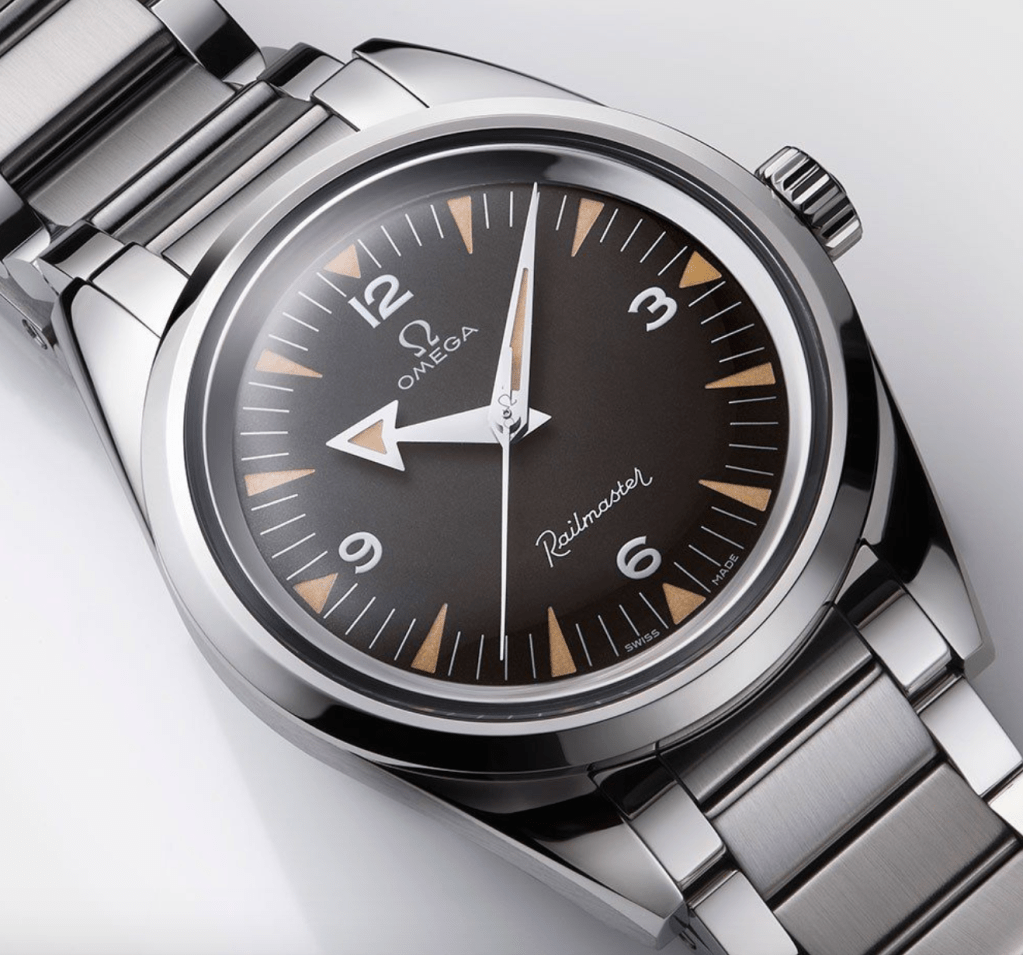
The bracelet (the watch comes with two other straps as standard in gorgeous retro packaging which even involves corduroy!) appears vintage but is only so to look at, again being engineered to the highest modern Omega standards (but is pleasingly still a very retro 19mm at the lugs). Like the dial on the watch (to which we will come) the clasp bears the Omega logo as it was in 1957 too, a trick which continues on the crown where, as well as the “old” Omega symbol, there’s also the mark they used to designate a watch that had a form of compressor crown as the original did (but the new one doesn’t – tech having left compression cases behind 25 years ago).
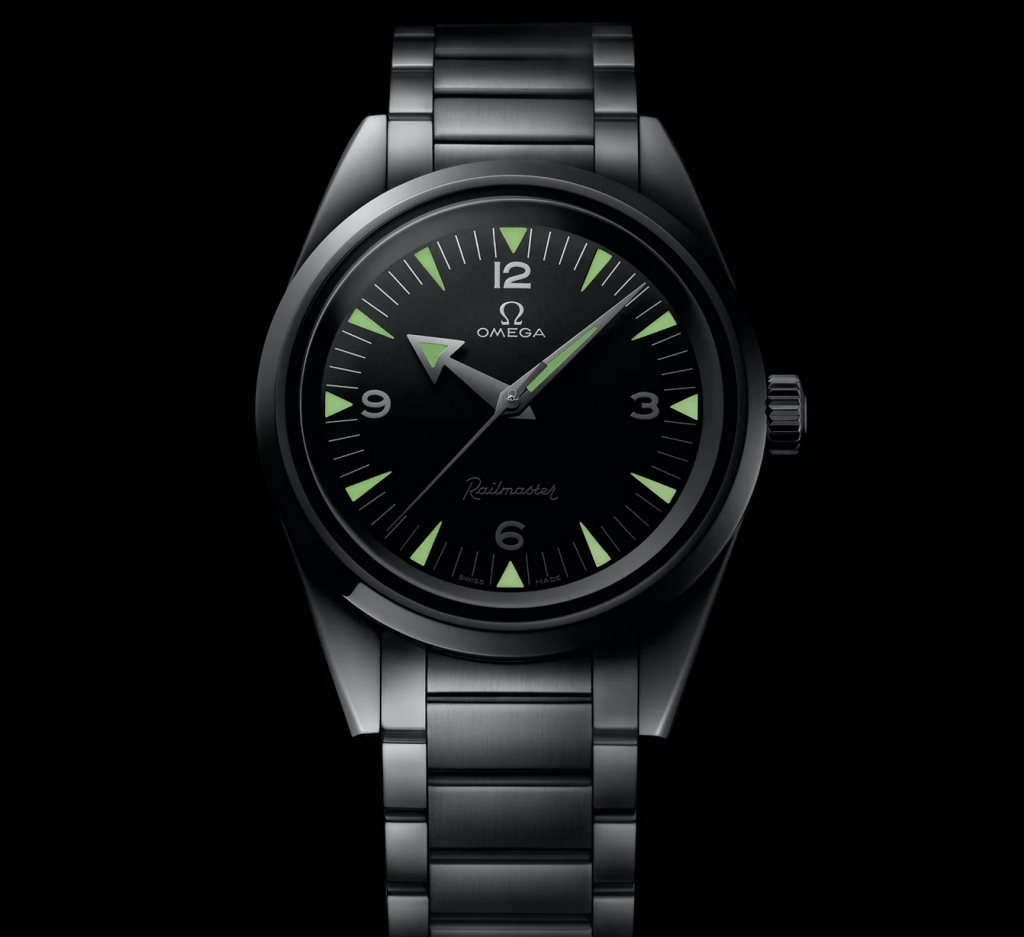
The matt black “tropical” dial is beautiful. Aside from materials used being the best available today, rather than in 1957, the key differences are the use of aged lume (something some dislike but I adore) to give that cream glow look, and the fact the triangular indices are sunk in to the dial to allow thicker lume to be used without that being obvious to the naked eye.
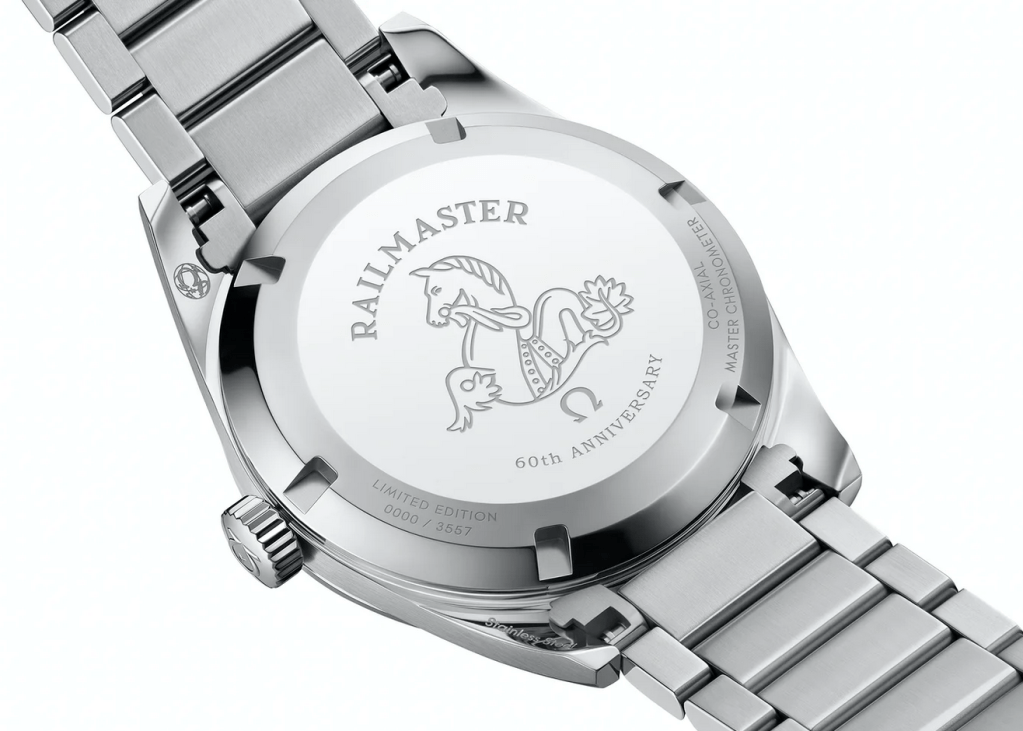
The largest change though is inside. Where the original ’57 Railmaster had a manually-wound movement its 2017 child goes automatic, and not just any automatic either. Despite having a solid, rather than display, case-back (quite right for a tool watch) inside the Trilogy Railmaster sits one of the greatest movements available outside the hand-built world of oligarchs and former members of Pink Floyd, the Omega Master Chronometer Cal. 8806, featuring the co-axial escapement designed by British watch genius George Daniels.
The 8806 is a Certified Master Chronometer, as approved by METAS. Self-winding and with a power reserve of 55 hours, it also features a free sprung-balance with silicon balance spring, and automatic winding in both directions. Despite that closed case-back, the Cal.8806 in the watch still carries the usual special luxury finish with rhodium-plated rotor and bridges with Geneva waves in arabesque which is visible when seen in display back Omegas. I like that touch. You can’t see it, but you know inside the case it’s as beautiful as it is effective.
And here’s a good bit. Whereas the original Railmaster could fend off magnetic fields of 1000 Gauss, more than most people would come across most days, the 2017 version can dispense with a massive 15,000 Gauss. When you consider how many magnetic fields we all come across these days thanks to the tech that surrounds us, that’s a very cool thing indeed.
It didn’t come cheap at 6,500 CHF but it is the original Railmaster’s “failure” that makes this very special limited edition so wonderful. The world is full of Speedmasters and Seamasters, wonderful things indeed, but all-too common. The “Trilogy Railmaster” is understated by design, and rare in terms of numbers. It looks like it came from the late 50s, despite performing like the very best of modern Swiss luxury watches; it’ll fly under the radar of most, and I think that makes it the modern Omega to have.
And crucially it’s not likely to appeal to Gavin and Tim.
 The Little Machines